Basement renovation guide
Radon in Ottawa Basements: Testing & Mitigation
Factual, health-aware guide to radon in Ottawa basements, why the region is high-risk, Health Canada’s 200 Bq/m³ guideline, testing, and sub-slab mitigation.
Radon is easy to ignore because you can’t see or smell it, but it’s worth understanding before you turn a basement into a bedroom or suite. Here are the facts, calmly, with no fear-mongering.
Why Ottawa is a high-radon region
Radon is a natural radioactive gas that rises from the ground, and Health Canada notes it can be found in almost any home in Canada, the Ottawa region included. It collects in basements, which matters most exactly when you’re about to spend more time down there.
Eastern Ontario’s geology means a meaningful share of Ottawa-area homes test above the guideline, regardless of the home’s age or how well it’s sealed. Because you can’t see or smell it, radon is easy to ignore, right up until you turn the basement into a bedroom or suite and someone starts sleeping in the room where it concentrates most.
Health Canada’s 200 Bq/m³ guideline
Health Canada’s guideline is 200 Bq/m³. Below that, you don’t need to act; above it, the gas should be reduced by a certified professional. It’s a clear, published line, not a judgment call, which is what makes radon straightforward to deal with once you measure.
That published threshold is what keeps this from being a fear-based upsell. Either your number is under 200 and you do nothing, or it’s over and there’s a defined, proven fix. There’s no grey area to be talked into, which is exactly why we test first and only recommend a system when the measurement calls for one.
Long-term vs. short-term testing
Testing is the only way to know your level. Health Canada recommends a long-term test of at least three months for an accurate reading; a short test can flag a concern, but the long-term number is the one you act on.
Radon levels swing day to day and season to season, they’re typically highest in winter when the house is closed up, so a three-month-plus test averages out the noise into a number you can trust. A two-day short test is useful for a quick flag (for example during a real-estate deal), but it’s the long-term reading you base a mitigation decision on.
What sub-slab depressurization does
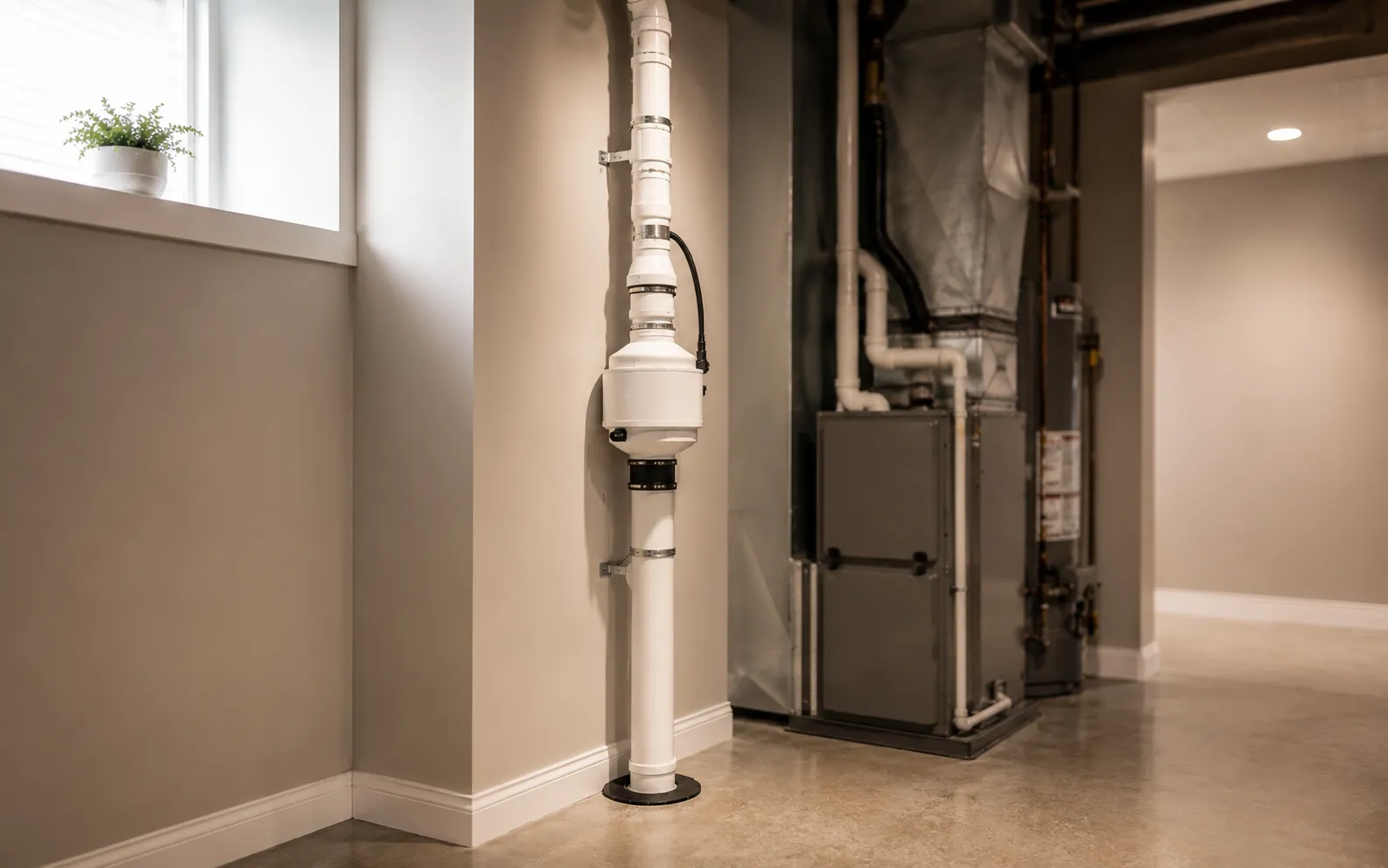
If your level is high, the standard fix is sub-slab depressurization, a quiet vent system that draws radon from under the slab and releases it safely above the roof. It usually installs in under a day and reduces radon by more than 80% in most homes.
The system is simple and unobtrusive: a pipe drawing air from beneath the slab, a quiet inline fan, and a vent that discharges above the roofline so the gas disperses safely outside. Once it’s in, it runs continuously in the background, you won’t notice it day to day, but it keeps the level down for the life of the home.
Building mitigation into a renovation
The smart time to handle radon is during a finish or suite build, while the slab and walls are open. Building the mitigation into the renovation keeps it tidy and hidden, rather than bolting it on awkwardly afterward.
During construction the pipe run can be hidden inside a wall or service space and the slab penetrations sealed as part of the work, so the finished basement shows no sign of it. Retrofitting later usually means exposed pipe and a fan bolted to an outside wall. Sequencing radon into the renovation is cheaper, cleaner, and the obvious move if you’re opening the basement up anyway.
Post-mitigation re-testing
After mitigation, re-test to confirm the level actually dropped below the guideline. Proof matters, the re-test is what lets you put a child or a tenant in that new basement bedroom with confidence.
The re-test is the proof the system worked, a measured number under 200, not just an installed fan. We use C-NRPP-certified professionals for the testing and mitigation so the measurement and the system meet Canada’s national standard, and you finish with documentation you can show a tenant, a buyer, or simply keep for your own peace of mind.