Basement renovation guide
Is My Basement Apartment Legal in Ottawa? (Checklist)
A non-judgmental compliance checklist, the common gaps that make an Ottawa basement apartment illegal, and what retrofitting to code actually takes.
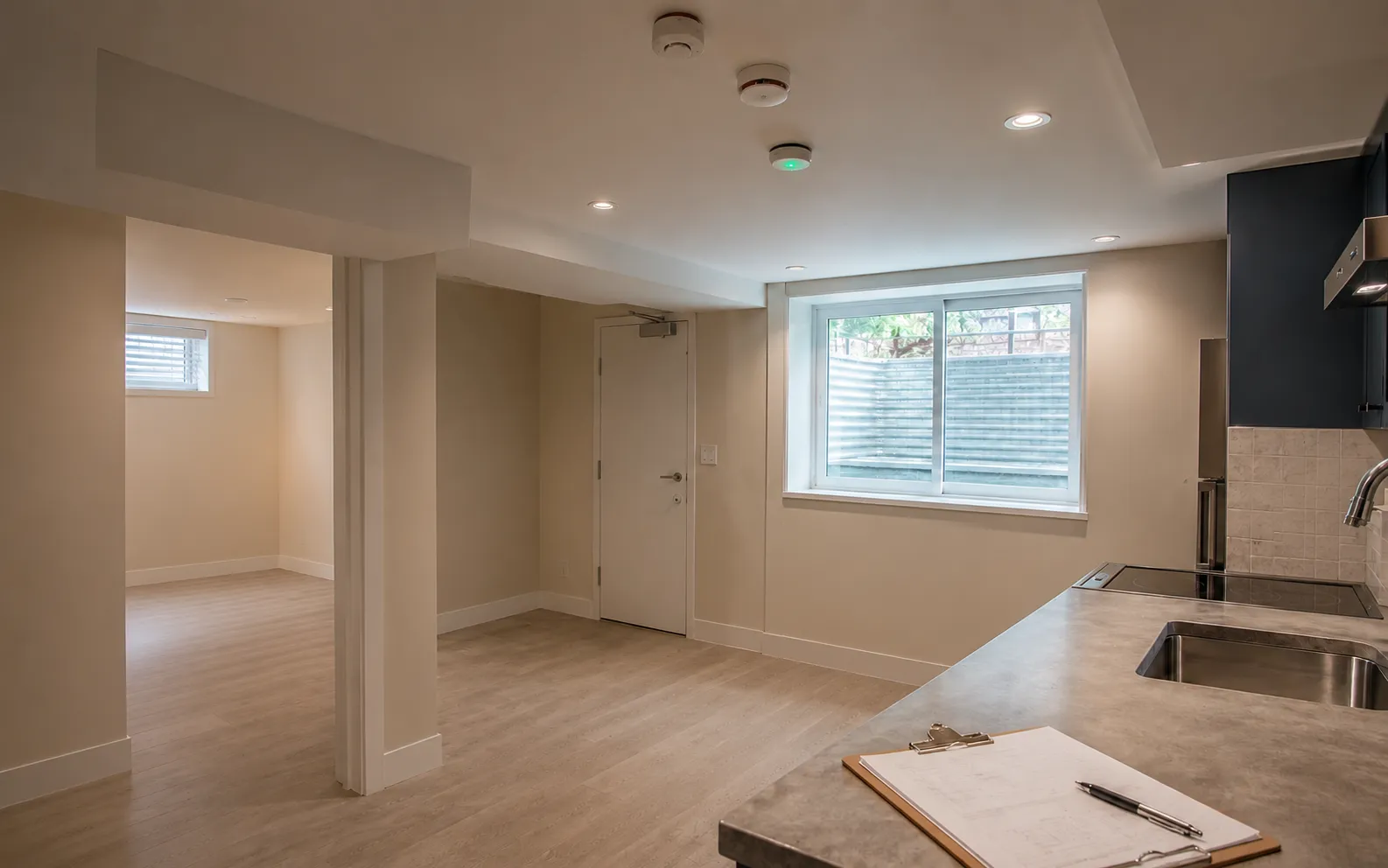
If you’re renting out a basement that may not be fully legal, you’re not alone and there’s no judgment here. Use this checklist to see where you stand, most gaps are fixable without tearing the unit out.
Fire separation: is it actually there?
Fire separation: is there a proper fire-rated barrier between the suite and the rest of the house? This is the most common gap, and it’s the one that matters most for life safety. If you’re not sure, assume it needs checking.
A proper separation is a rated assembly, typically fire-rated drywall on the ceiling and shared walls, with penetrations and the door between the unit and the main house properly sealed. Ordinary drywall, a hollow-core door, or open mechanical penetrations don’t count. This is the item most often missing in units that were finished casually or inherited with the house.
Egress: can someone get out?
Egress: can someone sleeping in the unit get out in an emergency? A bedroom needs a compliant, climb-through egress window. A unit with no real second way out is the clearest sign legalization work is needed.
Walk the bedroom and ask: if the stairs were blocked by smoke, could a person climb out the window? It needs a clear opening large enough to escape through, openable without tools, and, if below grade, a window well sized to climb out of. A small slider near the ceiling is the classic non-conforming window, and enlarging it is one of the more common retrofit steps.
Interconnected smoke alarms
Interconnected alarms: legal units need smoke and CO alarms that are interconnected, so one going off triggers them all. It’s a relatively small fix with an outsized safety payoff.
Interconnection is what wakes a tenant asleep in the basement when the fire starts upstairs, a standalone alarm two floors away may never be heard. It’s among the cheapest items on this list to bring up to code, and there’s no good reason to leave it undone given how directly it protects the people living there.
Ceiling height and permits
Ceiling height and permits: confirm the ceiling meets the required height and that the work was actually permitted. Missing permits are common in inherited units and can be resolved by applying now and bringing the work up to code.
Height is the one gap that can be expensive, because the only real fix is underpinning or floor-lowering, so it’s worth measuring early. Permits are usually more straightforward: you apply now, the work is inspected, and the unit becomes documented. An assessment tells you which gaps are quick fixes and which, if any, need structural work.
Insurance and liability if you do nothing
Doing nothing has a cost: an unpermitted, non-conforming rental can void your insurance and expose you to serious liability after a fire or injury. Legalizing is protection, not just compliance.
The risk is asymmetric. The unit earns rent quietly until the day there’s a fire, a flood, or an injury, and then an insurer can deny the claim and you can be personally liable, because the unit was never legal. Set against tens of thousands in potential exposure, the retrofit cost is modest, and it converts a hidden risk into documented, insurable value.
The retrofit-not-rebuild path
The good news: in the large majority of cases this is a targeted retrofit, not a rebuild. We upgrade the specific items that don’t meet code and leave your finished unit intact, far less cost and disruption than starting over.
We start by identifying exactly which of these gaps apply to your unit, then close only those, add the fire separation, enlarge the egress, interconnect the alarms, pull the permit. Your existing kitchen, bathroom, and finishes usually stay. A full rebuild is rare and almost always tied to a serious ceiling-height shortfall, which we’ll flag plainly rather than letting you discover it mid-project.